

I came to Cebu last year because my children were finally old enough to fend for themselves. No more packing snacks, negotiating nap schedules, or managing the chaos of family travel. Just me, the festival, and three million other people crammed into the Queen City of the South for Sinulog.
What I thought I’d find: colorful costumes, synchronized dancing, maybe some insight into why Filipinos love the Santo Niño so fiercely.
What I actually found: a festival built on top of a burning.
THE STORY THEY TELL (AND WHAT THEY LEAVE OUT)
The official narrative goes like this: On April 14, 1521, Portuguese navigator Fernando Magellan anchored off the shores of Cebu commanding a Spanish fleet of three ships—the Trinidad, Concepción, and Victoria. He arrived not as a tourist but as the vanguard of empire, carrying royal banners, trade goods, and the instruments of conversion.
Rajah Humabon, who controlled Cebu’s port and its lucrative trade networks, initially approached the encounter pragmatically. This was a man used to negotiating with Chinese merchants, Malay traders, and emissaries from the Srivijaya and Majapahit empires. Cebu wasn’t a backwater—it was a node in a complex web of maritime commerce that stretched from China to the Moluccas.
But Magellan didn’t come to trade as an equal. He came to claim. Within days of arrival, he performed a Requerimiento—the Spanish legal ritual that “offered” indigenous peoples a choice: accept Christianity and Spanish sovereignty, or face war. It was conquest dressed up as invitation, a legal fiction that allowed the Spanish crown to frame violence as a justified response to “rejection” of God’s grace.
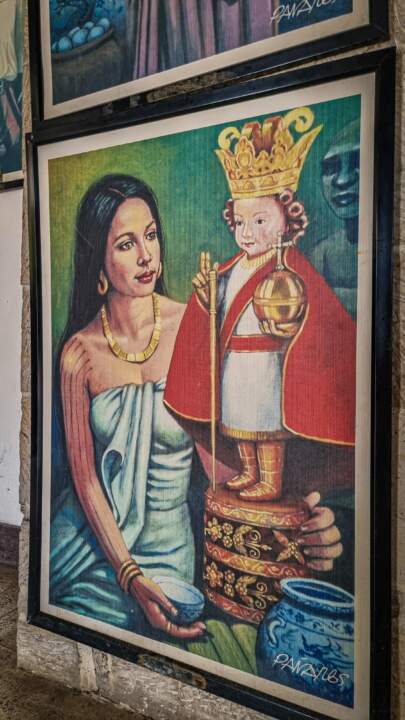
Hara Amihan (Queen Juana after baptism) was Humabon’s wife, and according to Pigafetta’s journal, she expressed particular interest in the image of the Santo Niño—a small statue of the Christ child carved in Mexico from dark mesquite wood. Magellan, seeing an opportunity, told her she could have it—but only if she and her subjects abandoned their anitos.
Pigafetta recorded that on the day of her baptism—April 14, 1521, performed by Father Pedro Valderrama, the fleet’s chaplain—Juana danced when she received the Santo Niño. He described it as spontaneous joy. Two steps forward, one step back. The movement that would become sinulog, mimicking the flow of the Pahina River alongside waving bamboo.
But joy under duress is complicated. This was a woman whose gods had just been consigned to fire, whose husband had entered a political alliance with armed foreigners, whose world was being reordered in real time. What looks like joy in Pigafetta’s account might also have been performance, strategy, or the ritual embodiment of grief.
WHAT THE FIRE DIDN’T DESTROY
Magellan left Cebu days later for Mactan, where Lapu-Lapu’s warriors killed him on April 27, 1521. The Spanish fleet limped away. The Santo Niño disappeared into Cebu’s collective memory for forty-four years.
When Miguel López de Legazpi returned in 1565 to finish what Magellan started, he came with overwhelming force: five ships, 500 soldiers, and explicit orders to establish permanent Spanish control. When a village refused to submit, Legazpi’s men razed it. In the ruins of a burning nipa hut, soldier Juan Camus reportedly found the Santo Niño intact, preserved in a wooden pine box lined with flowers. It was wearing simple clothing—a flounced shirt and a red velvet bonnet—and holding a round ball without a cross, with a small golden necklace around its neck. The elaborate royal vestments, crowns, and scepters would come later, added over centuries by Spanish colonial administrators and devotees who dressed the image like a king. Legazpi interpreted this as divine endorsement—proof that God wanted Spain to rule these islands. He built a church on the spot where the image was found, which became the Basilica Minore del Santo Niño, the oldest Roman Catholic church in the Philippines.
The statue itself is small—barely 30 centimeters tall—but it carries enormous symbolic weight. It was carved in Mexico, survived a shipboard fire during the Pacific crossing (which darkened its wood), disappeared for over four decades, and re-emerged unscathed from another fire. This triple survival became the core of its miraculous reputation.
In 1740, Pope Clement XII granted the image canonical coronation, elevating it to one of the most venerated objects in Philippine Catholicism. In 1965, Pope Paul VI declared the church a Minor Basilica. In 2021—exactly 500 years after the first Catholic baptisms in the Philippines—both the Santo Niño image and the Basilica were declared National Cultural Treasures by the National Museum, recognized for their “outstanding historical, cultural, artistic and/or scientific value.”
Today, the statue is encased in bulletproof glass inside the basilica. It is dressed in different vestments throughout the liturgical year—sometimes as king, sometimes as priest, sometimes in the regalia of specific devotions. Pilgrims press against the barriers, holding up their own Santo Niño replicas to be blessed by proximity.
THE DANCE THAT CARRIED FORWARD
But here’s what’s crucial: the sinulog dance predates the Santo Niño.
Pre-colonial Cebuano communities already had ritual dances that mimicked the movement of rivers, the sway of bamboo in wind, the rhythms of planting and harvest. The two-steps-forward, one-step-back pattern wasn’t invented by Hara Amihan’s “spontaneous” joy—it was already embedded in the kinetic vocabulary of the islands.
What Christianity did was redirect it. The dance survived by changing what it pointed toward. Instead of honoring water spirits or ancestral presence, it now honored the Christ child. The kubing (indigenous bamboo percussion) and drums that once accompanied ritual offerings to local deities now accompanied Catholic procession.
This is how colonization works when it’s thorough: it doesn’t erase the old forms—it repurposes them. It takes the body’s memory and gives it a new script. The sinulog became Catholic, but the movement itself remembers something older.
By the time the Spanish formalized the Sinulog Festival in the 17th century, it had become a hybrid form—indigenous choreography performing Christian devotion, wrapped in Spanish pageantry. The irony is that this hybridity is what allowed the dance to persist. If it had remained purely “pagan,” it would have been suppressed. If it had been purely imported Catholicism, it wouldn’t have resonated with local memory. The sinulog survived by being both and neither.
CEBU, LAST YEAR: SPECTACLE AND SWEAT
Landing at Mactan-Cebu International Airport, I was immediately disoriented by scale. The “Queen City of the South” wasn’t the provincial cousin to Manila I’d half-expected. Glass towers caught the afternoon light. Shopping malls sprawled across reclaimed land. Restaurants and bars pulsed past midnight. This was a city that had absorbed centuries of trade, colonization, and globalization and emerged as something restlessly modern.
But underneath the skyline, the old colonial grid still holds. Spanish-era street names—Colon, Magallanes, Legaspi—overlay a much older geography of barangays, riverine trade routes, and pre-colonial settlement patterns. You can still trace where the shoreline used to be before reclamation pushed it further out. The Basilica sits near what was once the heart of the port district, where Chinese junks, Malay praus, and later Spanish galleons would have anchored.
I spent the days before Sinulog wandering this palimpsest of a city. I visited heritage houses along Sikatuna and Zulueta Streets, their capiz windows glowing like honeycombs, wooden barandillas carved in lace patterns. I ate at pungko-pungko stalls where workers squatted on low benches, plates of puso (hanging rice) and fried chorizo balanced on their knees. I stood in the old Parian district—once Cebu’s Chinatown, where mestizo merchants built fortunes on the galleon trade—and tried to imagine what it looked like before the Americans bulldozed half of it for wider roads.
And everywhere, already, was the Santo Niño. In taxi dashboards. In storefronts. On murals painted across entire building sides. Cebu doesn’t just host the Santo Niño—it organizes itself around the image.
THE BASILICA: DEVOTION BEHIND GLASS
In the days leading up to the festival, I tried multiple times to get inside the Basilica to see the original Santo Niño. Each time, the crowd was too dense. Thousands of devotees flocked to have their own Santo Niño images blessed by priests. Parents brought children—even infants—to be touched with holy water and blessed in front of the image. The line snaked around the block. Families camped on the steps. Street vendors sold candles, rosaries, anting-anting medallions side by side. The sacred and the commercial collapsed into each other without friction.
The Basilica itself feels like a fortress. Thick stone walls, iron grilles, guards at every entrance. The Santo Niño is locked behind bulletproof glass now, protected from the very crowds who venerate it. You can’t touch it. You can’t get close. You can only press forward with your own replica and hope proximity transfers some grace.
Inside, the air was thick with incense and body heat. People knelt on marble floors worn smooth by centuries of knees. They whispered petitions, lit candles, took photos with their phones held high. An elderly woman wept openly in front of the image. A young couple held hands and prayed for a child. A man in a wheelchair was pushed to the front by friends who wanted him closer to the glass.
Faith is messy. It doesn’t fit neatly into theological categories or historical analysis. It happens in the press of bodies, the flicker of votive light, the hoarse whisper of a prayer you’ve said so many times the words have worn smooth.
THE GRAND PARADE: CHOREOGRAPHY AND CHAOS
By the time the Sinulog Grand Parade rolled around, I’d already walked enough of Cebu to earn blisters. The parade route stretched through the city streets down to the SRP (South Road Properties) grounds, a massive reclaimed area that now hosts the main performances.
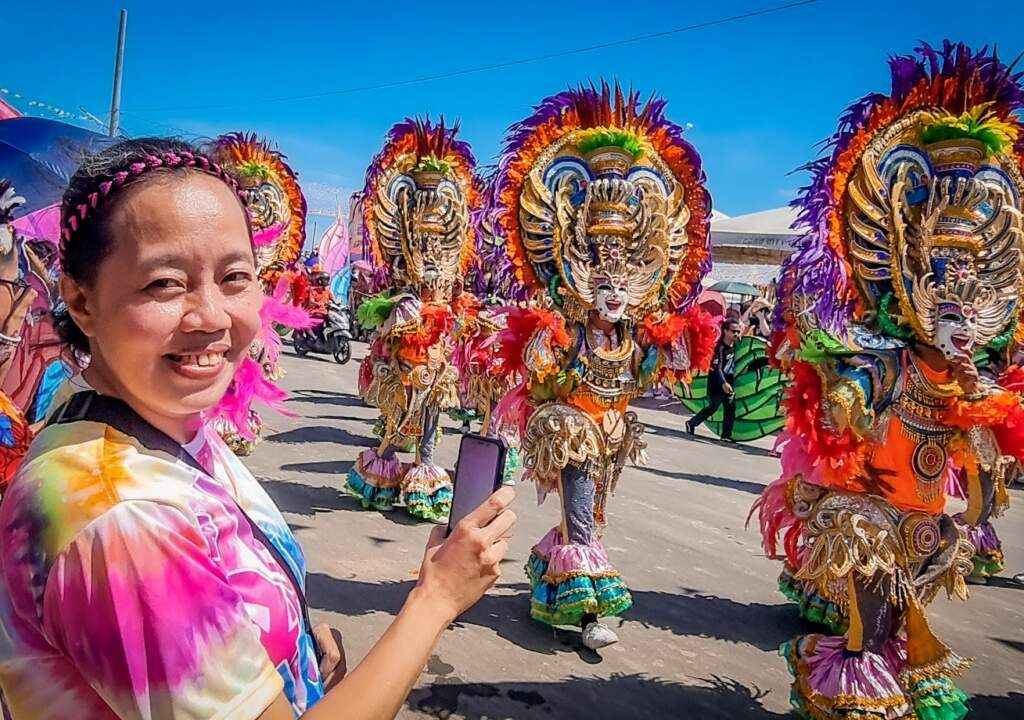
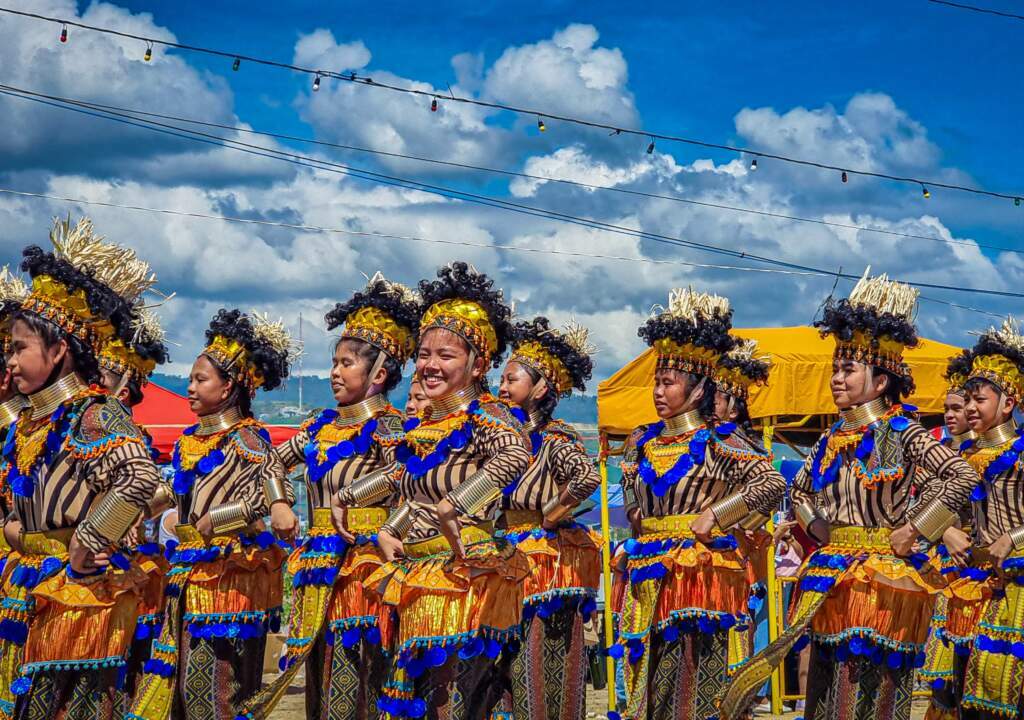
Getting in was a disaster. Thousands of people bottlenecked at the gates. Organizers couldn’t agree on which entrance was actually open. Police waved us in conflicting directions. The heat was punishing—midday sun with no shade, asphalt radiating heat like a griddle. I watched contingents of child dancers, some no older than six or seven, standing in full costume and makeup, sweating through their sequined tops, waiting for hours past their scheduled performance time.
The schedule collapsed entirely. What should have been a tightly coordinated event turned into a test of endurance. I felt terrible for the dancers—mostly kids—who had to brave the extreme heat with no water stations in sight. My smartwatch logged 15,000 steps that day, most of them walking in circles trying to find a spot with shade, trying to navigate the chaos.
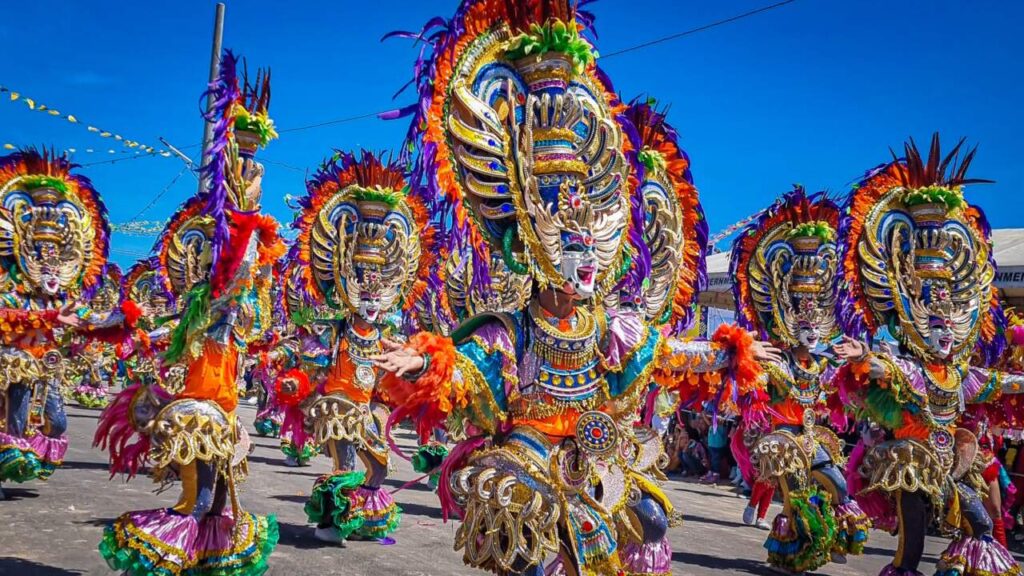
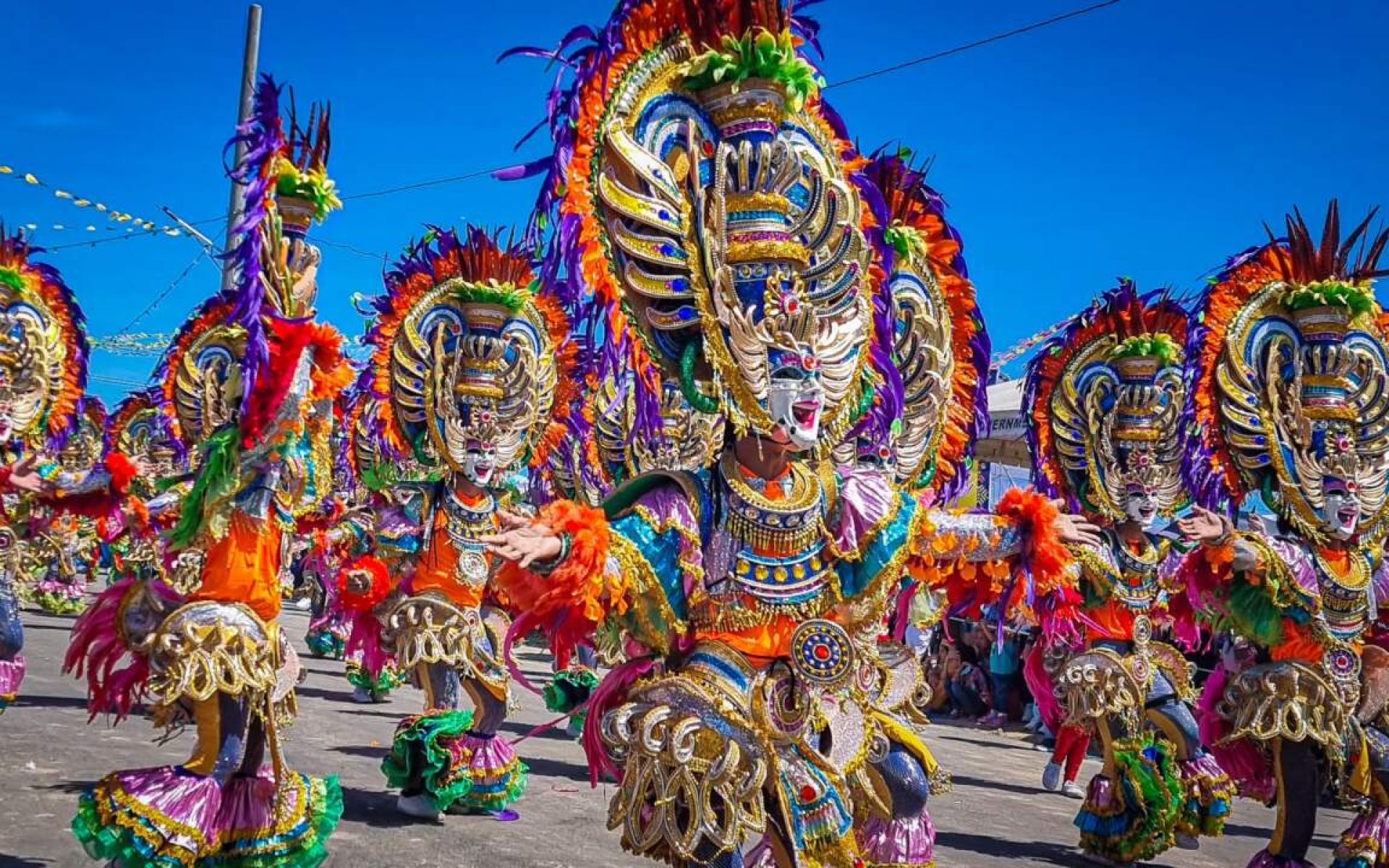
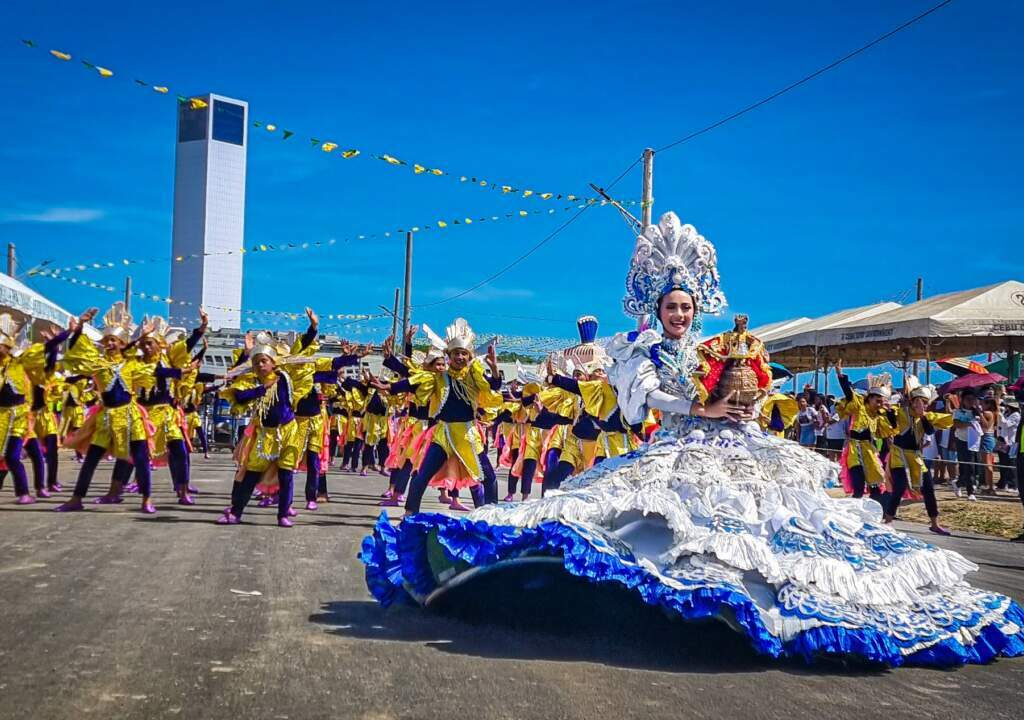
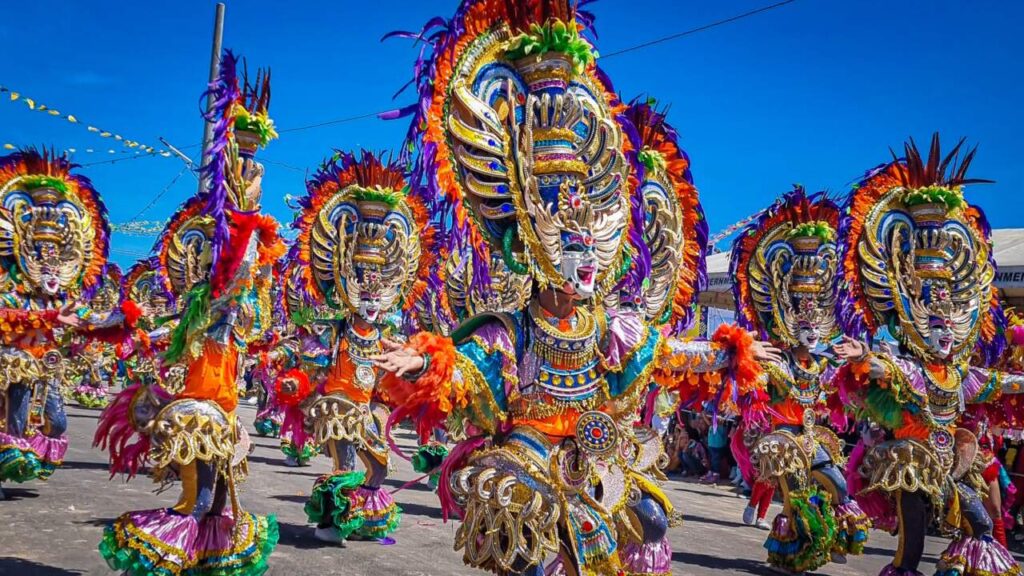
Inside, the production was enormous. Over 3,000 performers across different contingents, each representing schools, barangays, corporations, or cultural groups. There’s the “sinulog-based” category, which requires dancers to use the traditional two-steps-forward, one-step-back rhythm. Then there’s the “free interpretation” category, which allows contemporary choreography, hip-hop elements, acrobatics—basically anything that loosely references Cebuano culture or the Santo Niño narrative.
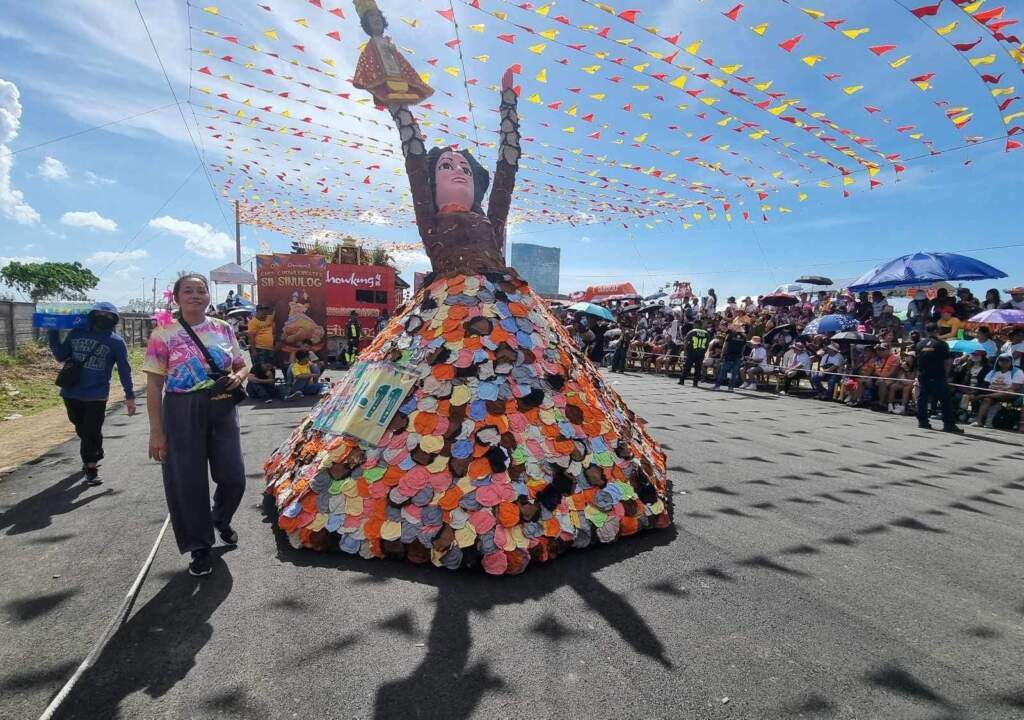
The costumes were spectacular: feathered headdresses taller than the dancers, beaded bodices that caught the light, flowing capes in neon green and electric blue. Some contingents went maximalist—giant mechanical props, pyrotechnics, dancers on stilts.Others stayed traditional—simple Filipiniana ternos, bamboo poles, and live drumming.
What unified everything was the relentless rhythm. Drums pounding. Brass blaring. The sinulog beat so consistent it burrowed into your skull. Even hours later, I could still hear it—boom-boom-chak, boom-boom-chak—the soundtrack looping endlessly in my head.
The official Sinulog theme song and “I Love Cebu” played on repeat until the lyrics wore grooves into my brain. Exhausted didn’t cover it. But even through the disorganization and the heat exhaustion, there was something undeniable about watching hundreds of bodies moving in synchronized precision. The collective energy was electric.
Watching the parade, I kept thinking about what this choreography represents. These are Cebuano bodies performing their own history—or at least, a version of it. The narrative they’re dancing is Magellan’s arrival, the queen’s conversion, the miracle of the Santo Niño’s survival. But the form of the dance—the steps, the rhythms, the collective synchronization—comes from somewhere older.
It’s a palimpsest in motion. Spanish Catholicism written over indigenous ritual, written over contemporary spectacle, written over civic pride and tourism revenue and the sheer joy of moving together in public space.
WHAT DEVOTION LOOKS LIKE AFTER 500 YEARS
Around the SRP grounds, vendors sold Santo Niño images in every size—pocket-sized keychains, foot-tall statuettes, life-sized replicas in glass cases. You could buy the image dressed as a doctor, a farmer, a king, or a warrior. One stall sold a Santo Niño in basketball shorts.
There was something deeply Filipino about this proliferation. We don’t keep our sacred images in hushed churches behind velvet ropes. We bring them into the street. We dress them up. We put them in our cars and our shops and our living rooms. The Santo Niño isn’t distant—it’s intimate, accessible, almost casual.
But this intimacy also carries the weight of history. Every Santo Niño image in Cebu is a descendant of the one Magellan gave to Hara Amihan. Every “Pit Señor!” chanted in the streets echoes back to that first coerced dance. The devotion is real—I don’t doubt that for a second. But its devotion is shaped by 500 years of colonization, syncretism, and survival.
THE COMPLICATIONS WE CARRY
After the parade, I sat in a carinderia near the old downtown, eating bulalo and trying to process what I’d seen. The broth was rich and sticky on my lips. Around me, families ate in comfortable silence, workers scrolled their phones, and a group of students debated the best contingent performance.
It occurred to me that most people at Sinulog aren’t thinking about colonial violence. They’re not interrogating the origins of the dance or the coercion embedded in the Santo Niño story. They’re just there—participating in something bigger than themselves, honoring a tradition passed down through generations, feeling connected to their city and their history and each other.
And that’s fine. That’s probably how culture works most of the time—unreflectively, through participation rather than analysis.
But I couldn’t stop thinking about the burning. About Hara Amihan watching her anitos consigned to fire. About forty-four years the Santo Niño disappeared—long enough for anyone who remembered the original context to die. About Legazpi building a church on the ashes of a razed village and calling it God’s will.
What does it mean to celebrate a festival born from this?
SYNCRETISM AS SURVIVAL
There’s a word for what Sinulog represents: syncretism—the blending of different religious or cultural traditions into something new. Scholars use it to describe how colonized peoples adapted to imposed belief systems by folding their old practices into new frameworks.
But syncretism isn’t a neutral academic term. It’s what happens when you’re not allowed to practice your religion openly, so you hide it inside the colonizer’s symbols. It’s what happens when forgetting means cultural death, so you remember by performing the new script with the old choreography.
The sinulog survived because it became Catholic. If it had remained purely “pagan,” the Spanish would have suppressed it as devil worship. If it had been purely imported Spanish devotion, it wouldn’t have resonated with local memory. The dance persisted through deliberate ambiguity—performed with such conviction that eventually no one could say where indigenous ritual ended and Catholic devotion began.
This is the genius and the tragedy of colonial survival. We keep our culture by transforming it into something the colonizer can’t quite recognize as resistance.
The Santo Niño itself is syncretic. It’s a Mexican-carved statue that survived Spanish fire, disappeared for forty-four years, re-emerged from Filipino flames, and became the Philippines’ most beloved Catholic image. It represents Christ, yes, but it also functions like the anitos it replaced—a material object that mediates between the human and the divine, something you can touch, dress, carry, speak to directly.
Filipino Catholicism is full of these doubled meanings. We pray the rosary, but we also wear anting-anting. We attend Mass, but we also consult albularyo healers. We venerate saints, but we also pour offerings for ancestors. The Church tried to draw clear lines between Catholic and “pagan,” but we’ve spent 500 years blurring them.
WHAT WE INHERIT, WHAT WE CHOOSE
I left Cebu sunburned, dehydrated, and still humming the Sinulog beat. My feet ached. My photos were mostly blurry from being jostled in crowds. I never made it inside the Basilica to see the Santo Niño behind its bulletproof glass.
But I came away understanding something I hadn’t before: Sinulog isn’t a relic of the past. It’s a living negotiation between what we were told to worship and what we refuse to forget.
The festival celebrates survival—not just the Santo Niño’s miraculous preservation through fire, but the survival of the dance itself, the survival of a distinctly Cebuano identity through centuries of colonization, war, dictatorship, and globalization. The fact that three million people still show up every January to dance in the streets is its own kind of miracle.
But survival came at a cost. We can’t talk about Sinulog without talking about the burning of the anitos, the violence of conversion, the way indigenous knowledge systems were systematically dismantled and replaced. We can’t celebrate the Santo Niño without acknowledging that its arrival marked the beginning of 333 years of Spanish colonial rule.
This doesn’t mean we stop celebrating. But it does mean we complicate the story we tell ourselves.
The standard narrative frames Sinulog as pure devotion, a joyful expression of faith. And for many people, that’s exactly what it is. But for me, walking through Cebu last year, I couldn’t stop seeing the layers beneath the joy—the coercion that started it all, the erasure that made it necessary, the stubborn persistence of bodies that kept dancing even when the music changed.
PIT SEñOR: A PRAYER AND A QUESTION
“Pit Señor” means to call, to ask, to plead to the king. It’s a prayer, urgent and direct. But I wonder: who are we really calling to?
The Santo Niño, yes. But also maybe the ancestors whose spirits were burned. The dancers who kept the sinulog alive when it could have been lost. The water that keeps flowing, two steps forward, one step back, refusing to be still.
Sinulog is what we inherited. It’s complicated, contradictory, and shot through with violence and resilience in equal measure. We didn’t choose this history. But we’ve made it ours anyway, pouring our grief and our hope and our stubborn joy into a dance that refuses to be just one thing.
That’s the uncomfortable truth of Filipino Catholicism, and maybe of Filipino identity itself. We didn’t choose colonization. We didn’t choose the Santo Niño. But we’ve carried both forward for 500 years, transformed them into something distinctly ours, and danced with them until we can no longer remember what came before.
The festival will happen again next year. The drums will pound. The dancers will move. Three million people will flood Cebu’s streets, chanting “Pit Señor!” with voices hoarse from devotion and heat.
And the sinulog will continue—two steps forward, one step back—carrying everything we’ve forgotten and everything we refuse to let die.