

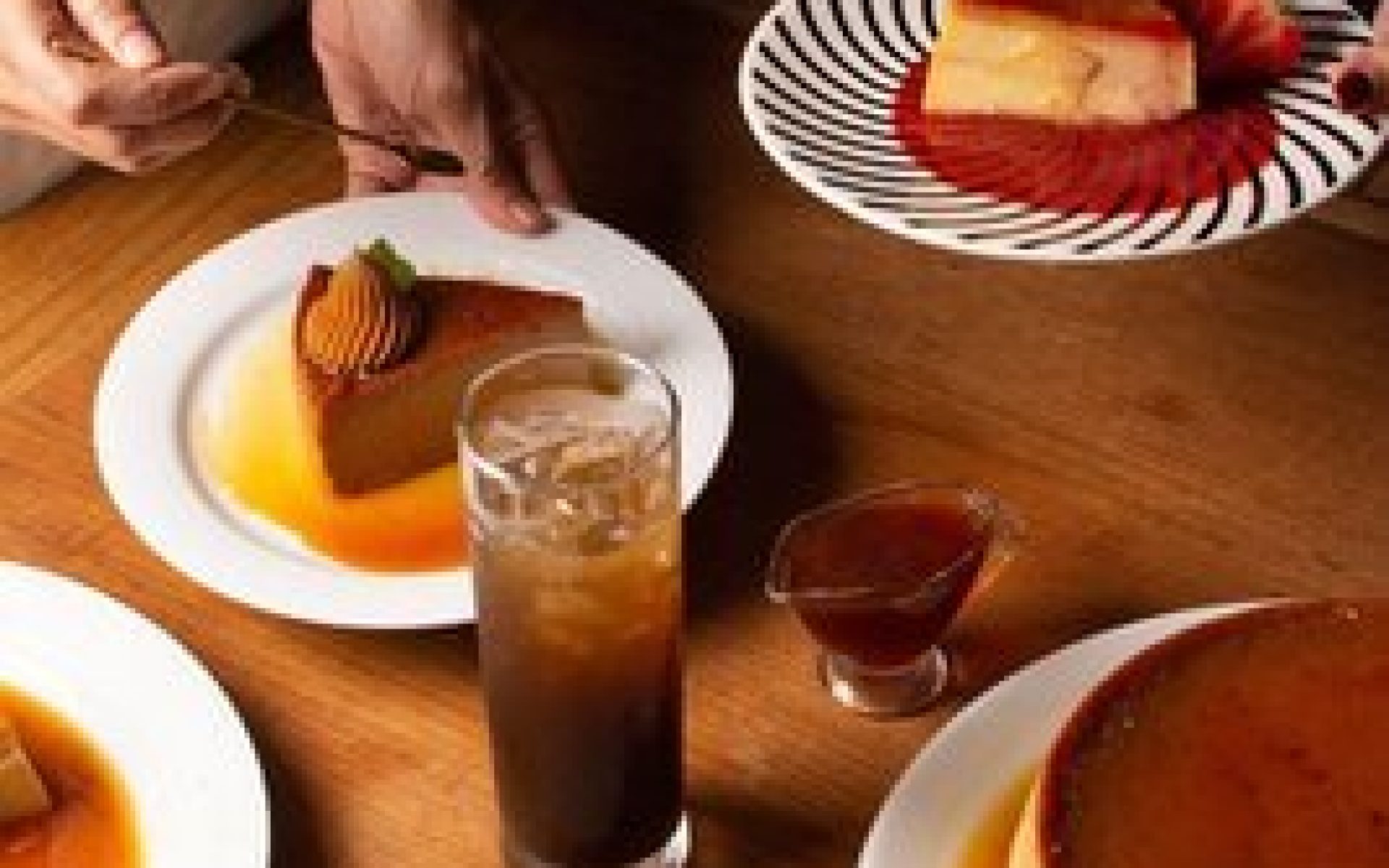

In my hometown of Marinduque, dessert has its own hour. The cool smoothness of leche flan just freed from its mold. The stained-glass gleam of cathedral jelly in a glass bowl. The faint clink of a spoon against a serving dish. And at fiestas, birthdays, and weddings, that hour begins at the presidential table.
The presidential table is the long table at the front of the hall, under a white backdrop edged with flowers and ribbons. It is the stage within the stage. Here sit the bisita de honor — the priest, the mayor, the principal sponsors, the balikbayan — facing the rest of us at the common table.
At the presidential table, the buko salad arrives in chilled bowls crowned with cherries. The leche flan, cool from its mold, sits on a fine platter. Special cakes stand with frosting still firm from the refrigerator. Plates are replenished before they are empty, the sequence unbroken: soup, lechon, rice, main dishes, cold dessert.
From the common table, the presidential table looks almost ceremonial. Garnishes, platters, and service follow a choreography that has been rehearsed for generations. Dessert is not simply the finale—in Filipino fiestas, it often shares space with the savory dishes, part of the visual abundance that defines the celebration [3]. The spread is meant to be seen as much as eaten.
As a child, I once wandered into the kitchen and saw a deep bowl of buko salad—pale green and pink, a scatter of red cherries on top. I reached for the serving spoon, but my aunt, without looking up, said, “Para sa bisita ‘yan” (That’s for guests). It was my first lesson that dessert here follows an order, and the first serving does not begin with you.
This practice is older than our town. Early 20th-century accounts describe the first table at large feasts—often for women of rank—served by male family members, their plates attended to before anyone else’s [2]. It was a display as much as a courtesy. In the Philippine fiesta, the presidential table became a public stage: the most visible table, with the best china, floral centerpieces, and printed cloths. To be seated there is to be recognized by the community. The protocol extends to the food: the choicest cuts of meat, the most elaborate dishes, and the finest desserts appear here first, before they travel anywhere else—if they travel at all [1].
Sweetness itself has a hierarchy. At the common table, desserts lean toward the familiar: kakanin, gulaman cubes, the occasional puto. At the presidential table, a cake from Conti’s might hold the center, surrounded by Red Ribbon boxes, with cups of jelly fanned out at the edges like a decorative border.
In many fiestas, these desserts carry reputations of their own. Leche flan, rich with egg yolks, is a sign of care and expense, often the first to vanish from the table [4]. Buko salad, with its canned fruit and sweet cream, signals celebration—a dish saved for occasions when the hosts wish to show abundance. Cathedral jelly, with its stained-glass colors, is more decoration than indulgence, completing the table’s look before it fills anyone’s plate. Each sweet has its place in the performance, as much about what it says as how it tastes.
The word minatamis is both adjective and past tense. It describes the taste—“sweetened”—and the act—“was sweetened.” It marks the work of transformation: coconut meat simmered into minatamis na bao, santol coaxed out of its sharpness and into syrup. Sweetness here is rarely accidental; it is the result of labor, stored, and served with intention.
I have seen the same pattern beyond my hometown. In Iloilo, the best pinipig ice cream appears only when the mayor’s wife is seated. In Quezon, pastillas de leche are passed among principal sponsors, skipping the younger guests entirely. In some towns, even halo-halo becomes ceremonial—glass for a chosen few, paper cups for the rest, and plastic cones from a cart for everyone else.
This care with dessert has roots in our history. In the colonial era, refined sugar was an export crop. What stayed behind was brown, coarse, and rationed. White sugar in abundance marked wealth, and perhaps that memory still shapes the order of serving—a trace of history lingering in the taste of fruit cocktail syrup [1]. Today, certain foods still carry an aura of being “more class”—often those that are imported, expensive, or labor-intensive [5]. This suggests that the richer the ingredients and the longer the preparation, the more likely the dish is to be reserved for honored guests.
There is also practicality. A fiesta can last all day, with guests arriving in waves. If the best desserts were set out all at once, there would be none left by mid-afternoon. Over time, practicality became etiquette, and etiquette became tradition. No one asks why the presidential table is served first; it is simply how the celebration moves [1].
Beyond the presidential table, there is another sweetness—the minatamis na saba sold outside the church, eaten while standing in the sun. The ginataang bilo-bilo made on a rainy afternoon when there is no one to impress. These are the democratic desserts, ready for whoever happens to be there, without a seating plan.
In some cultures, dessert is abundant in the open. In a Greek home, baklava is passed until every hand is sticky with honey. In a Mexican fiesta, pastries stay at the center of the table, inviting second and third helpings. In my town, dessert moves slowly from one table to another, portioned with care.
Perhaps one day the leche flan will arrive at both tables at once, the buko salad set out before the pancit is gone. The sound of dessert—the clink of spoon against glass, the scrape of syrup from the bottom of the bowl—would then belong to the whole room, not just the stage. But whether served first or last, sweetness here always means more than sugar. It marks honor, hospitality, and the quiet understanding that some flavors are worth waiting for.