

A history of arnis and how this precolonial Philippine national martial art finds a home in UP Diliman
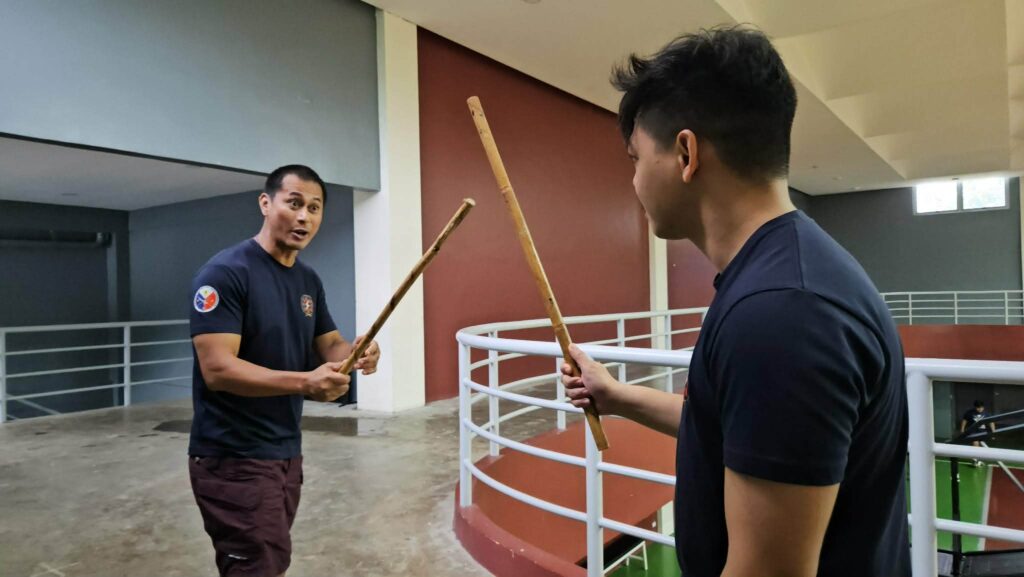
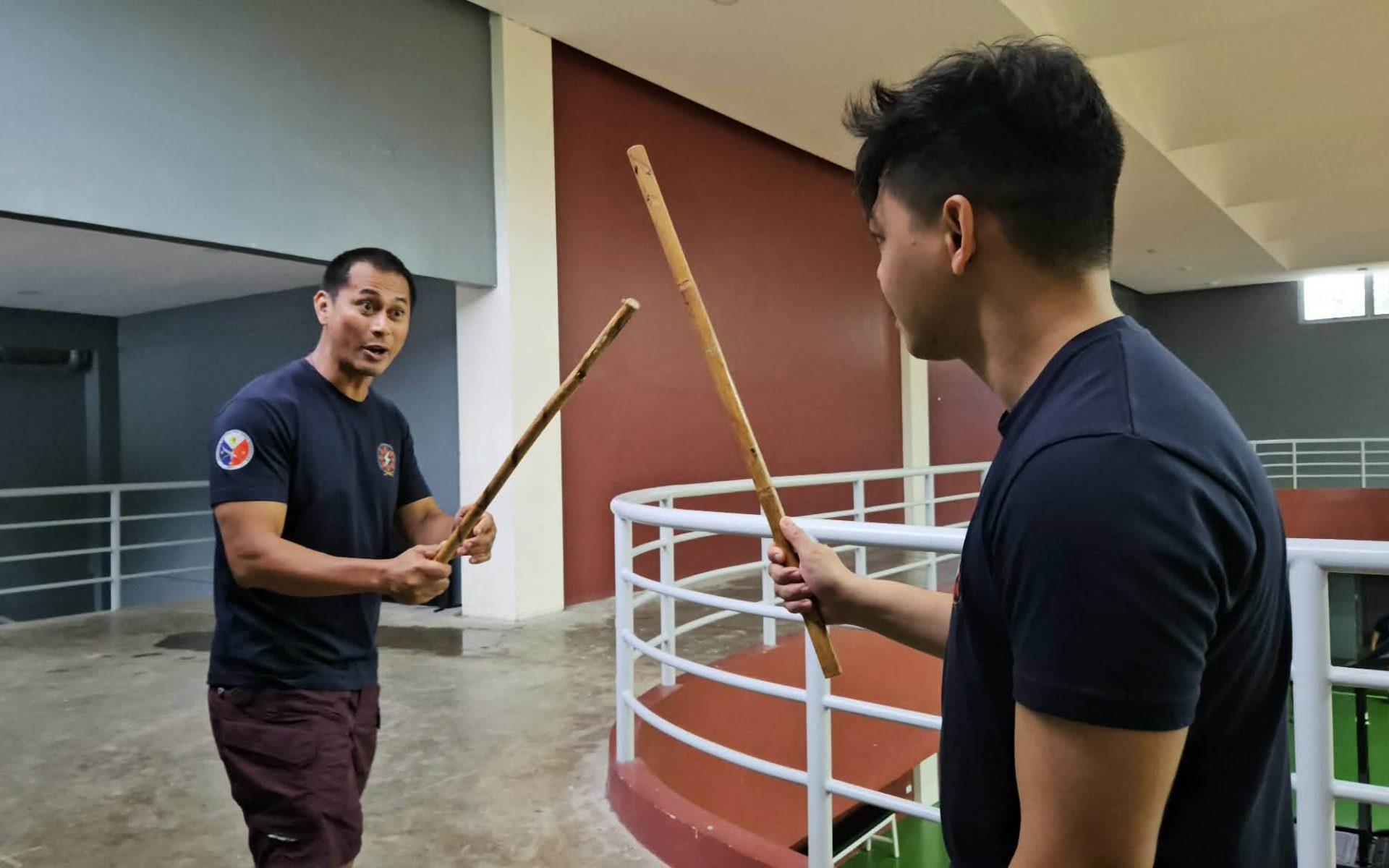
Nearing the Ylanan Gym, I hear the first staccato wave of clacks emanate from the area inside where lecturer Nathan Dominguez teaches the national martial art in PE class. The Ylanan Gym, where arnis is taught, and the Martial Arts Room inside the University of the Philippines – Diliman (UPD) DMST Complex, where the Tellu Bituun Bagani club trains, are located at the northernmost part of the verdant UPD campus, at the intersection of Commonwealth Avenue and Ylanan Street in Quezon City.
I turn nostalgic as moments from three decades past invade my mind’s eye; when my ears were regaled by the rhythmic percussion and my eyes were fixated on the dizzying hand speed with which arnisadors wielded their wooden sticks, one crashing against the other in offense, defense, and in between.
It’s the Vanguard Building martial arts room again, one Saturday afternoon in the dwindling last quarter of 1998. The Lema Scientific Kali Arnis System (LESKAS) Club, based in the Diliman campus of the country’s leading university, generously lent the space to our wrestling sessions, which ran from 4:00 PM to 6:00 PM. After our class on the rubber mat, arnisadors took center stage to commence their deadly Cariñosa, wooden sticks firmly in their hands, as daylight loosened its grip and dusk began to cloak the campus.
Arnis: A Precolonial Sport
Arnis traces its roots way back to Philippine precolonial history when the natives of our archipelago trained and fought in weapon-based fighting using sticks, swords, and knives. The use of rattan sticks among arnis practitioners eventually became popular when the three-century Spanish colonial era prohibited the Filipinos from carrying swords. Our ancestors were also compelled to camouflage the practice of the art under the guise of the performing arts: folk dancing and theater art.
Ideas abound on the exact origin of arnis, given the scarcity of historical documents to back up any particular narrative. Many suggest that it is originally a foreign art, imported from beyond the country. In his article, Arnis: A Question of Origins (Rapid Journal, 1997), anthropology professor and arnis scholar and instructor Felipe P. Jocano Jr. disputes this:
“To state, therefore, that its origins lie outside the Philippines is misleading, for it disregards the unrecorded but no less real experiences our forefathers went through in simply trying their best to survive. What is also important is that we remain open-minded, willing to improve our understanding of the origins of this martial art. Such open-mindedness is useful inasmuch as it provides us with further insights into our identity as Filipinos.”
Currently, arnis is considered the Philippines’ National Martial Art and Sport by virtue of Republic Act No. 9850 of 2009. It also mandates that it be taught in schools nationwide and played as a regular sport of the annual Palarong Pambansa.
That arnis is formally taught, studied, and practiced in UPD further ensures the survival and promotion of the country’s indigenous martial art and sport. And, I dare say that one welcome advantage of this martial art compared to others is its inclusivity.
Looking at the jovial faces of the trainees, one couldn’t help but notice the diversity: they come and strike in different sizes, of builds widely considered as athletic and otherwise. Their differences in demeanor are also perceptible, with some unmistakably on the extroverted side, while others are more reserved. Regardless of differences, they are all one in making music with their sticks and true Filipino martial artists in their own right.
Flashback: Me Versus Arnis
One morning, nearly a decade ago, I challenged my fifth-grade son, Mikael Fedor, to test the arnis skills he learned in PE class. With his dark brown kamagong stick in hand, I’ll try to subdue him with my bare hands. By then, I had been practicing and teaching grappling for almost two decades, but mainly as a sport and so much less as a form of self-defense outside the mat. Unlike some of my friends who belong to the Filipino Martial Arts (FMA) community, I was neither into self-defense against weapons nor disarming.
But I had to satisfy my curiosity and ego and placed my faith in the following plan: feign a kick, and when that distracts him, grab him before he gets the chance to strike. Mikael accepted the challenge. We stood face-to-face two meters apart. I raised my right foot and extended my leg towards him at a 45-degree angle, and the next instance I was on the bedroom floor writhing in pain. I grimaced and groaned in a fetal position with both hands cupped on my shin. I ended up on the wrong end of somebody else’s highlight, along with the abrupt realization of why weapons are weapons—and arnis sticks are no less.