
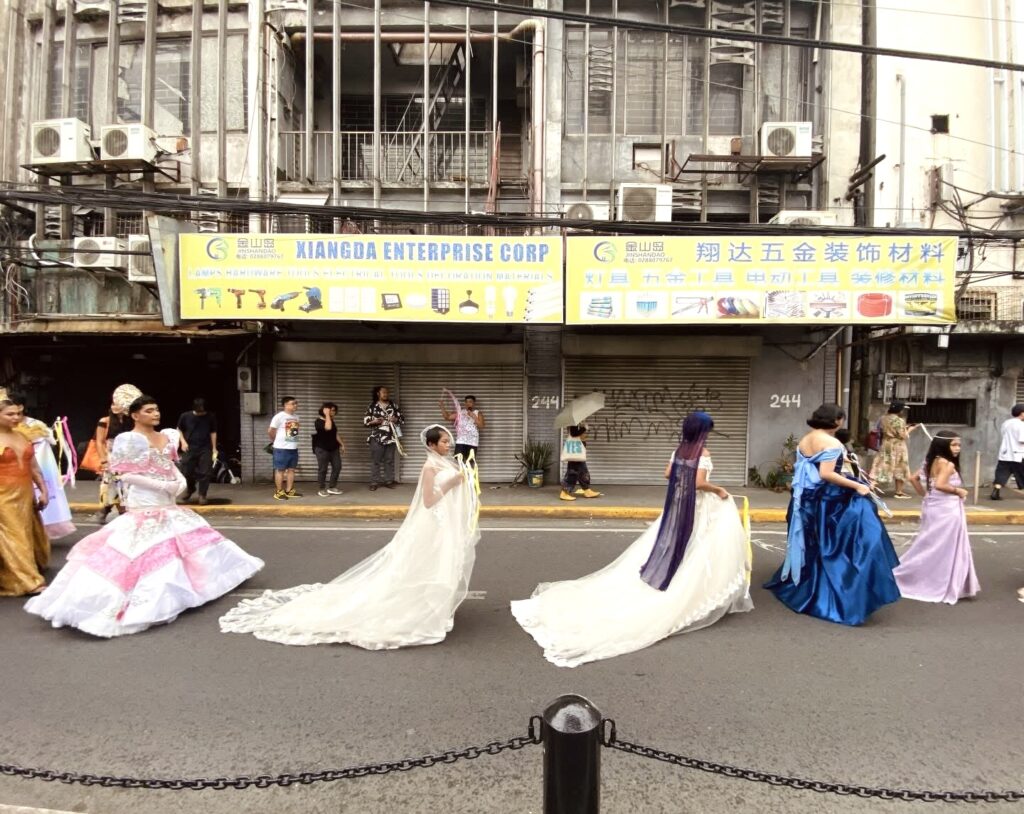
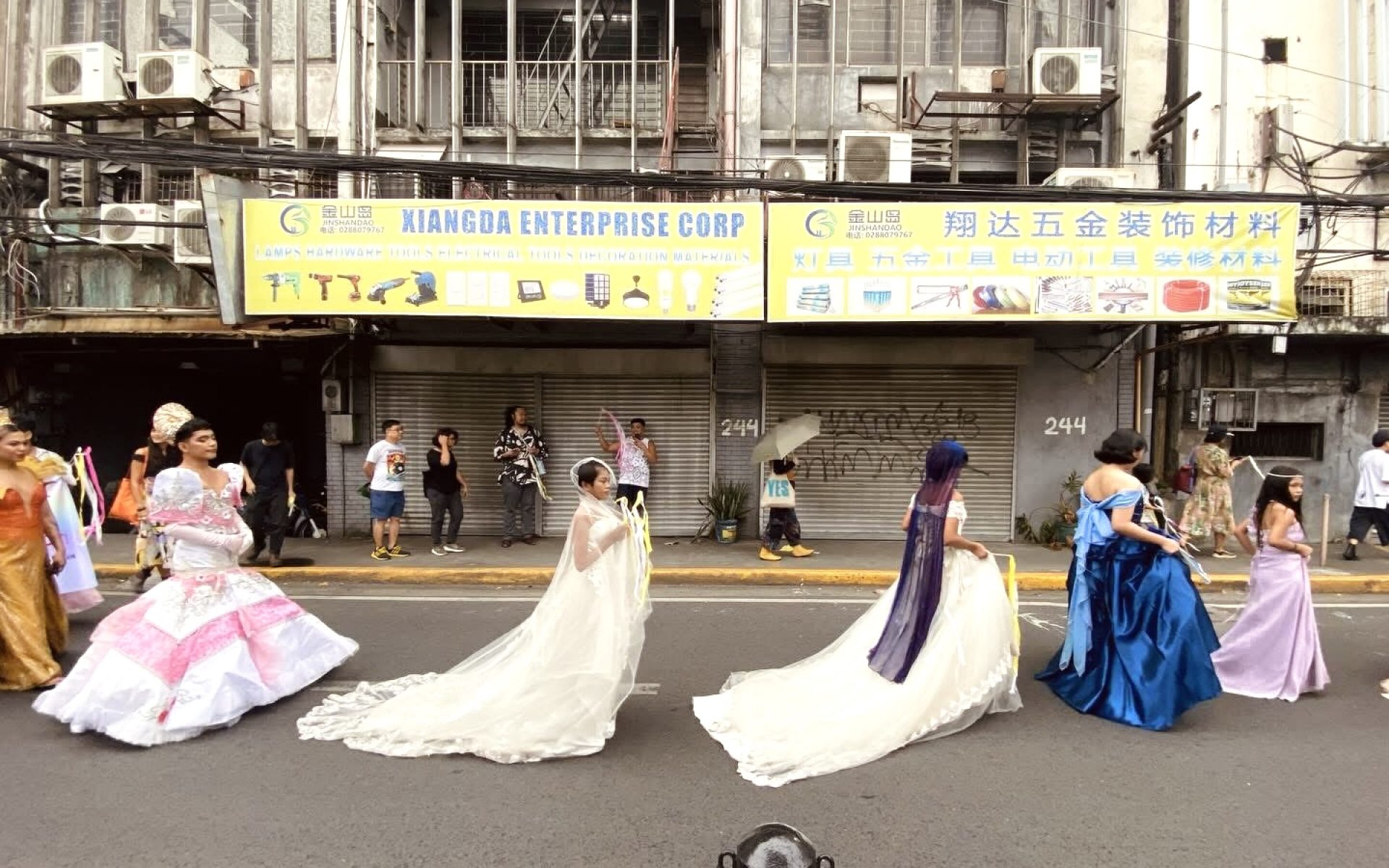

Carrying the festival theme, “Tambay lang,” this year’s Biennale spotlighted London-based walking artist Alisa Oleva and Pasig-based performance maker and cultural worker Istifen Dagang Kanal and asserted that lingering is a right and, especially for those pushed out of public space, is a form of resistance.
It was my first time going to Escolta. Coming from the province, my idea of Manila had been shaped mostly by films—jeepneys rumbling through crowded streets, vendors shouting over the noise, traffic forever threatening to spill past its limits. For days, I had been preparing myself for that version of the city.
Yet on the afternoon of December 7, 2025, the Manila streets felt muted. The usual humidity clung to my skin, but the air carried a strange stillness, as if the city had momentarily forgotten itself. A faint scent drifted between buildings, mixing with exhaust and something floral I couldn’t quite place.
As we walked toward the First United Building, formerly the Perez–Samanillo Building, its presence pulled me in. Designed in 1928 by Andres Luna de San Pedro, its Art Deco façade glowed dully in the afternoon light. The chipped egg-white paint peeled like old parchment; the curved balustrades resembled calcified vines crawling across the structure. It reminded me of the ancestral houses back home—weathered, persistent, held together by memory and slow decay.
Yet around it, modern Manila pulsed: LED billboards screaming for attention, delivery riders weaving through chaos, office workers power-walking as if racing time itself. The clash was unmistakable—old Manila standing its ground in a city that rarely pauses long enough to look anyone in the eye. For a moment, I felt as though I had stepped into a Nick Joaquin story.
Growing up in Cagayan, my family warned me relentlessly about Manila. Ingat. Delikado ang kalsada. Under Duterte’s regime, the streets became synonymous with fear—sites of surveillance, checkpoints, and EJKs that left families in mourning and neighborhoods in quiet, unspoken grief. Public space felt weaponized. I learned to treat streets not as extensions of community but as thresholds of danger. Manila existed in my imagination as a place one survived, not lived in.
Yet that day, the city shifted before my eyes. The ESC Biennale 2025—98B COLLABoratory’s biennial gathering of artists, installations, and wandering spectators—offered me a new narrative. The festival theme, “Tambay lang,” appeared unassuming, even casual, but its simplicity carried a quiet defiance. It asserted that lingering is a right. That presence—especially for those pushed out of public spaces—is a form of resistance.
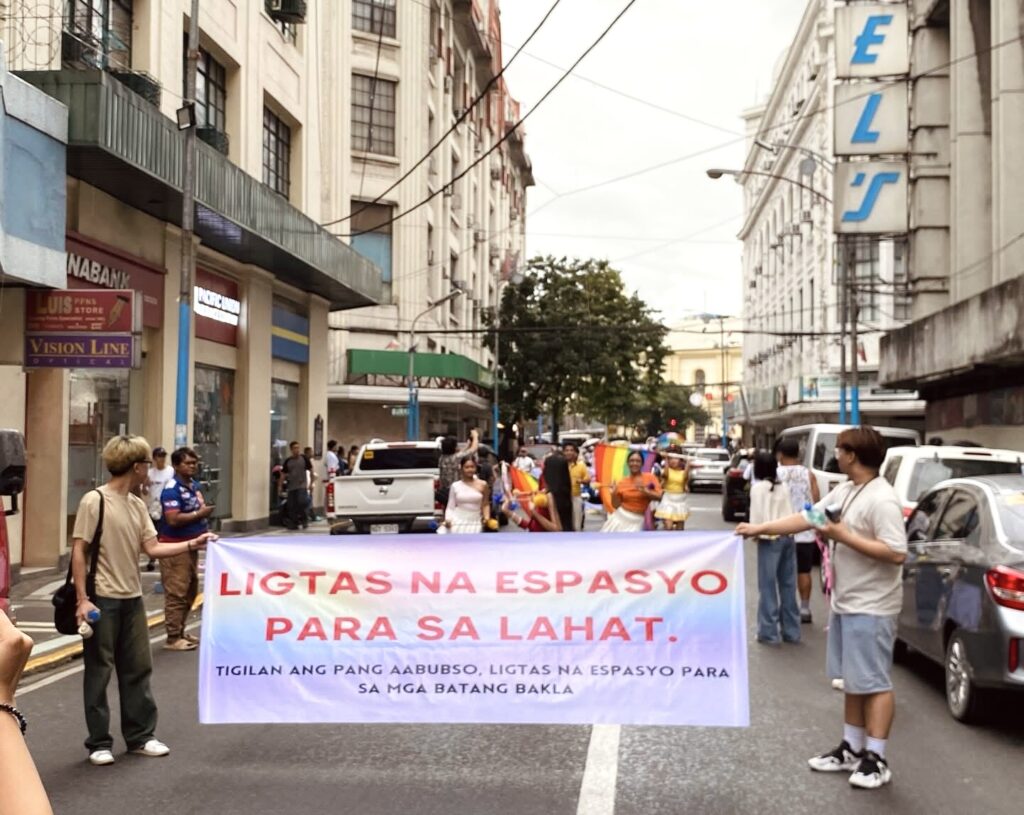
“Tambay lang” reclaimed the street as a site of rest, encounter, and community in a city that often demands movement, invisibility, or caution. This year’s Biennale spotlighted London-based walking artist Alisa Oleva and Pasig-based performance maker and cultural worker Istifen Dagang Kanal. It was Istifen’s “Bahay, Bata, Bakla: Paraduhh” that cracked Escolta open.
Before the performance, I saw the queer kids first. They had transformed the shadowed corner of the First United Building into an impromptu dressing room. One kid dabbed loose powder onto a friend’s cheek; another traced a wing so sharp it could slice the afternoon light. Their white gowns—some too long, some pinned hastily at the waist—fluttered whenever motorcycles sped by. Softness against concrete, glitter against exhaust fumes, queer joy shimmering in a space never built with them in mind.
Around them stood the “Mothers” and “Queens,” adjusting wigs, snapping open fans, offering last-minute banter and guidance with the steady authority of people who have survived much—people long relegated to the margins of our own streets. Activists held placards calling for accountability, healthcare, and the end of HIV/AIDS stigma. The scene felt like a counter-history: a colonially built street finally holding the bodies it once tried to erase. Escolta, long shaped by commerce and colonial memory, was allowing itself to be rewritten.
Watching them, I wondered: What could my childhood have been if I had this?
If I had been allowed to be soft, seen, unafraid? Many queer kids grow up in homes where safety is conditional, where queerness is a secret or sin. For us, the street becomes refuge—dimly lit tambays, whispered confessions, stolen moments of becoming. We learn to build community in the in-between spaces.
As National Artist Ricky Lee wrote in Si Amapola sa 65 na Kabanata, bahagi ka ng lahat—you are part of everything. That line finally felt tangible. These kids weren’t intruding on the street; rather, they completed it.
Writing this now, I write for the queer child in me. I dream of a world where no queer kid grows up thinking their existence is unworthy—that they may not only claim their space but also learn how to carve it. When the parade finally moved, Escolta shifted. The city—harsh, unpredictable—felt momentarily gentle. For an afternoon, the streets belonged to us. For an afternoon, we were home.